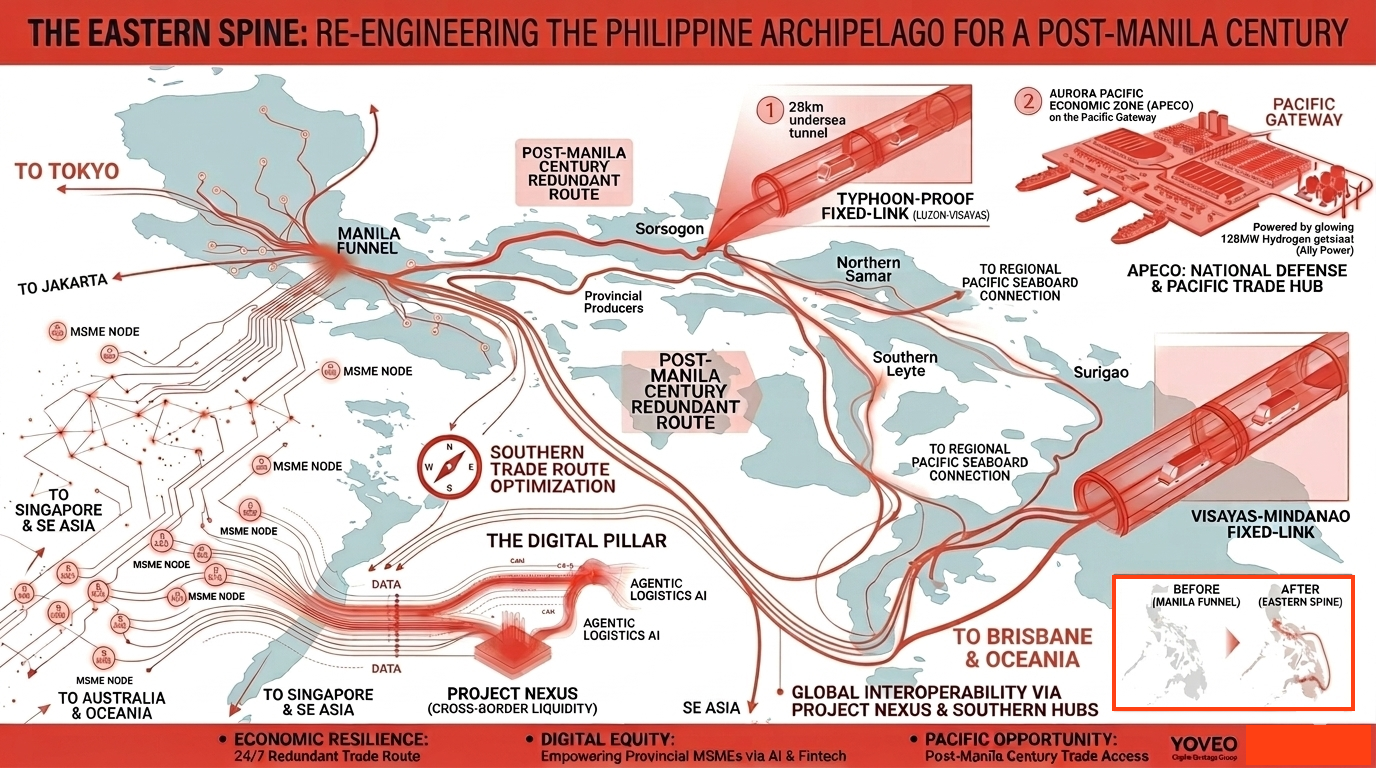
For over a hundred years, the Philippine economy has been a prisoner of the “Manila Funnel.”
Whether it is maritime traffic, digital infrastructure, or commercial opportunity, nearly 80% of our national trade flows through a single, congested capital. This over-reliance has created a “Typhoon Tax”—a hidden cost of doing business where a single disruption in the West Philippine Sea or a week of heavy swells in the San Bernardino Strait cascades into a national supply chain crisis.
In 2025 alone, maritime trade in that strait was halted for a combined 42 days due to weather. For a nation of 7,000+ islands, being “closed for business” for over a month is no longer an acceptable baseline.
As we step into the 2026 ASEAN Chairmanship, it is time to pivot. We are proud to introduce the Eastern Spine Architecture: a strategic roadmap to decentralize the national economy and activate the Pacific Seaboard.
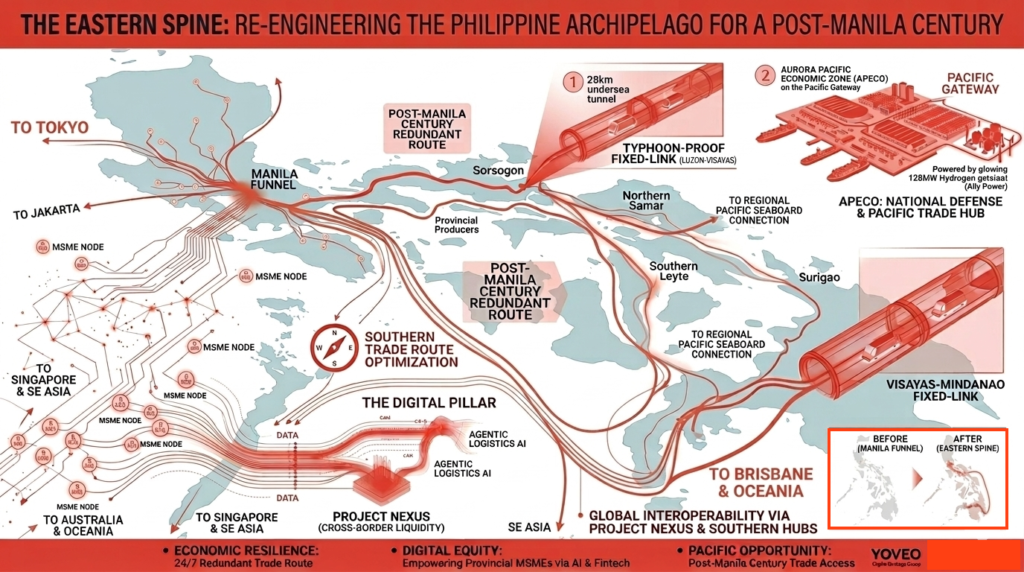
The Eastern Spine isn’t just a route; it is a re-engineering of how our nation breathes, trades, and grows. Our strategy rests on three interconnected pillars:
We are moving beyond weather-vulnerable ferry routes. The 2026 General Appropriations Act has allocated ₱130M for definitive feasibility studies of permanent island links.
Unlike bridges, undersea tunnels are “typhoon-proof,” ensuring that trade remains 24/7 regardless of the season. By connecting our three major island groups permanently, we create a redundant trade backbone that bypasses the Manila bottleneck entirely.
Infrastructure creates access, but Digital Literacy creates participation. Physical roads are useless if our local producers can’t navigate the digital ones. Following the Digital-PINAS framework, we are empowering MSMEs with:
The Eastern Spine positions the Philippines as a primary gateway to the Pacific. By modernizing ports like Zamboanga with AI-managed yard systems and renewable energy—such as the 128MW Hydrogen project at APECO—we are creating “Green Ports” (GRaSPS) that meet global standards.
With the launch of the ASEAN Center of Excellence for MSMEs in 2026, we are ensuring that our small exporters are not just participants in regional trade, but leaders of it.
The roadmap is ambitious but clear:
At YOVEO Digital, we believe in an “Analog Advantage” powered by digital resilience. The Eastern Spine is more than a logistical project; it is a commitment to Malasakit—ensuring that no island, no province, and no MSME is left behind by the tides of history.
The Philippines is no longer just an archipelago waiting for the capital to move. We are a Pacific power, ready to navigate our future, together.
Interested in the full technical brief? Download the Full White Paper: YD-2026-STRAT-001