Claude’s Invisible Watermark Changes How Marketers Create Content
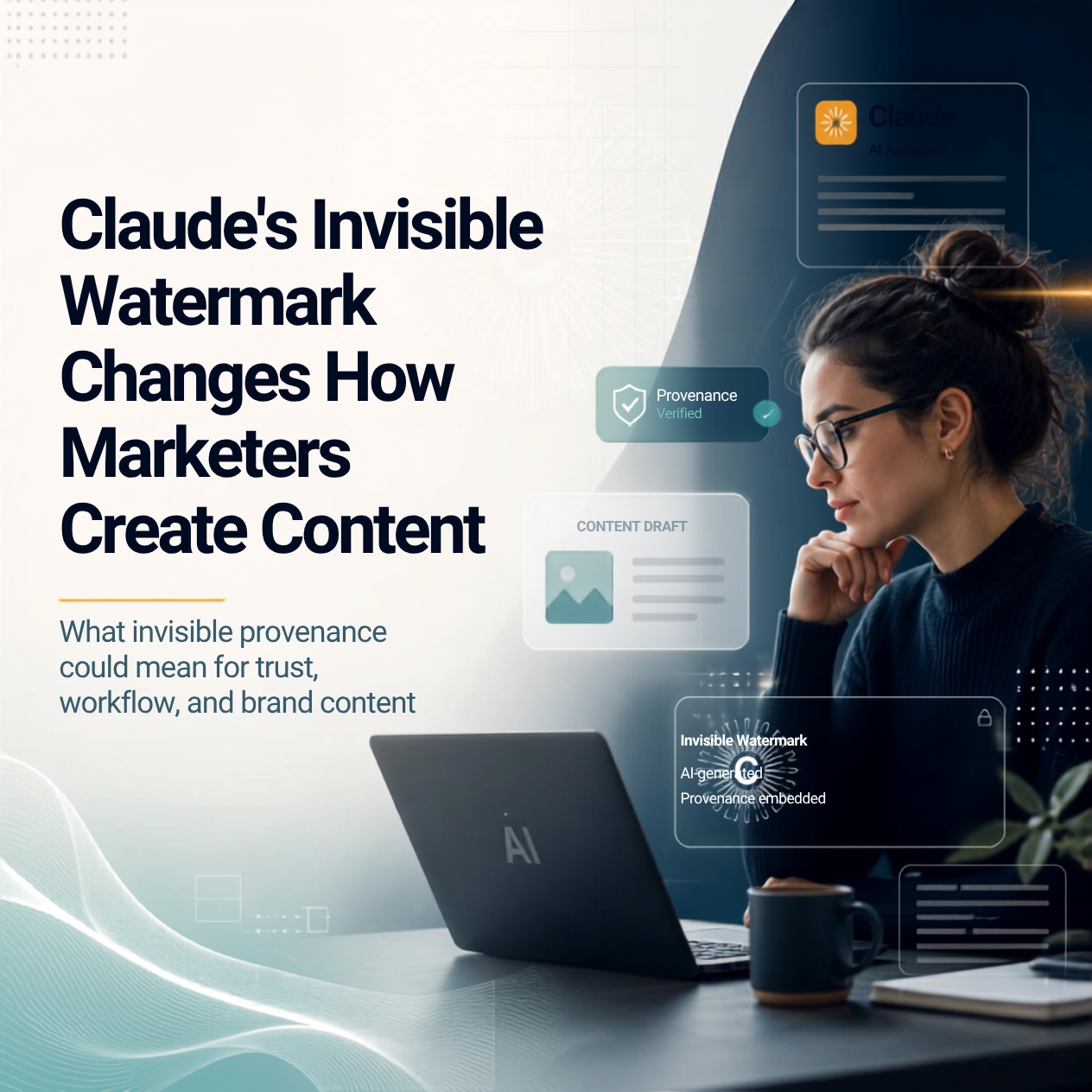
If your marketing team relies on Anthropic’s Claude for drafting campaigns, polishing SEO copy, or building content outlines, your SEO strategy and content workflow just got hit with a major plot twist.
To comply with global regulations like the EU AI Act, Anthropic has silently integrated invisible, statistical text watermarking across every single Claude output worldwide.
The Mathematical Fingerprints
This is not about hidden metadata, zero-width spaces, or code you can strip out with plain-text formatting. Anthropic leverages a statistical algorithm (like Google DeepMind’s SynthID-Text) that subtly influences word choice.
- The Micro-Choice Engine. When generating text, Claude slightly weights specific word pairings according to a proprietary secret key.
- Human-Invisible, Algorithm-Obvious. To a reader, the copy sounds completely natural. To search engines and compliance detectors, the mathematical distribution of word choices screams “AI-generated.”
- System-Wide Standard. The mark is applied at the foundational model level—meaning web apps, API calls, and third-party integrations all embed on the signature automatically.
Marketing Impact Matrix
| Feature | What It Means for Your Agency / Brand |
| No “Off” Switch | Applies universally across web interfaces, APIs, and integrated marketing stack tools. |
| Pasting Fails | Copying text into Google Docs, WordPress, or your CMS retains the underlying statistical pattern. |
| Light Edits Don’t Cut It | Fixing typos, changing a verb, or tweaking headlines will not break the detector’s threshold on longer posts. |
| Asset Metadata | Generated SVGs, PNGs, or code assets now carry cryptographically signed C2PA provenance tags. |
The Big Risk: The Copy-Editing Trap
The critical blind spot for marketers is not generating raw text—it is the false-attribution penalty. If an editor writes a 2,000-word original thought-leadership piece and asks Claude to fix grammar or optimize tone, the revised output will carry the watermark. Detection algorithms will not mark it as “Human-authored, AI-assisted.” They will simply flag the entire block as synthetic content, diluting your brand’s unique voice and exposing your organic footprint to search engine penalties.
- Claude’s Invisible Watermark Changes How Marketers Create Content
- What Is Generative Engine Optimization (GEO)? A Plain-English Guide for Small Business Owners
- Everything You Need to Know About Meta One: Features, Pitfalls, and ROI
- How to Get Found by ChatGPT: A Small Business Owner’s Guide
- How to Automate Facebook Messenger: Hand Off Hot Leads & Sync Orders to Google Sheets
How to Protect Your Organic Strategy
- Use Claude for scaffolding only. Let AI handle keyword grouping, structural outlines, and topic ideation. Draft the actual final prose in-house.
- Force heavy paraphrasing. Restructure syntax, swap vocabulary, and weave in proprietary data or real-world anecdotes to destroy mathematical signature.
- Short-Form Exemption: Quick social media captions and ad copies usually lack character length for statistical detection.
Publishing raw AI outputs without heavy human intervention is no longer viable. Marketers who treat AI as a research partner rather than a ghostwriter will maintain high-ranking search positions and preserve audience trust.
Lorna Bondoc is the Founder of YOVEO Digital, a women-led digital marketing agency based in Cebu City, Philippines. For more than a decade, she’s helped small business owners across the Philippines, the Pacific Islands, Australia, and New Zealand build websites and marketing systems that actually work — without the jargon or bloated retainers. Lorna is a vocal advocate for accessible, inclusive web design, leading YOVEO’s Bridging the Gaps program to close the digital divide for women-owned and underserved MSMEs across the Asia-Pacific.